
Material Choice
Facing resistance with creativity and integrity
Before jumping into today’s post, a quick update on my new book Jesus and Stoicism: The Parallel Sayings, which was originally scheduled to be published next week. Publication has been delayed by a month due to printing issues. It is now scheduled to be released on March 17.
Thank you to everyone who pre-ordered the book! You will receive your print or electronic copy as soon as it comes out in March.
And now on to today’s piece de resistance…
Resistance: Mental, Moral, Material
Working with material—every material—is a journey, more interesting, without a destination, full of surprises and stubbornness, and, most of all, deeply transformative of our state of being.
Christopher Bardt, Material and Mind
What does it mean to be material? Most of the time when we do practical ethics, we take for granted the fact that we’re physical beings in a physical world—we don’t really think of it at all. Yet our bodies, anchored as they are in material surroundings, are the most basic fact of our existence. Before we can manipulate our thoughts or strive to be become good and happy, we have to understand how to get around and survive in our environment. This is what we spend the first few years of our lives doing—assisted, of course, by the more experienced humans who raise us—so that by the time we reach an age where we can think about philosophy, all of the hard work of developing our spatial navigation and physical competence is already complete. We have already learned to sit up, walk, run, open a door, tie our shoes, and make ourselves a sandwich. We know to look both ways before crossing the street, not to stand in a puddle of water while plugging in an electrical cord, and to wash our hands before we eat. If we didn’t know these basic things, we wouldn’t last for long in our hazard-filled physical world.
The fact is, while we are alive in this world, we are material. We eat and we are edible (to borrow a phrase from Andreas Weber’s Matter and Desire). Just like every other part of the natural world, we are made up of natural elements that will be recycled into the earth after our death. And just like every other creature, we rely on material to stay alive—a fact so obvious it shouldn’t even need to be mentioned, but which can be easily forgotten if we don’t mention it.
This is the central thesis of Christopher Bardt’s thought-provoking book Material and Mind: that human perception, thought, language, and creativity are the result of our physical interactions with the world, and that our ability to live a full human life is severely compromised when we neglect this physical relationship. Our hands are made to touch and grip; our language and thoughts depend on visuospatial neural circuitry that shapes the way we think. Our bodies are made to meet with physical resistance. When we move through the world, it’s supposed to push back at us, force us to exert ourselves, demand that we reshape ourselves around it. As Bardt notes,
Every process unfolds in its own unique way through bumps and failures. Forward motion and backtracking are familiar features and essential aspects of creativity. Why? Materials and media have resistance. They resist our efforts to force them to conform to intent. They wreck our plans. They can become the boulder blocking the road. Over the years, I’ve watched hundreds of students arrive at that moment of frustration and boredom, ready to give up. It is truly a remarkable moment: the emotional tenor seems so pessimistic, yet it is a necessary precondition for true insights. Resistance wakens the imagination.
Material and Mind, p. 215
Bardt is speaking here about the creative process—he has for many years been a professor of architecture at Rhode Island School of Design—but the same principle applies across many aspects of human life. Resistance is crucial to development. If everything came easily, if we didn’t have to work for anything, we would develop into flattened, uninspired versions of ourselves. This applies not just to art and design but to dealing with physical hardship, difficult choices, rough relationships, and any other forms of resistance we may encounter. As Bardt points out,
All materials and physical media resist and react to action on them, each in its own profound way. Creativity is birthed in the crucible of resistance. When habitual ways are stymied, when we can no longer proceed, creativity becomes necessary.
Material and Mind, p. 215
The Greek Stoics famously said that our primary goal is to have a good flow of life, but this doesn’t mean that we flow without facing any obstacles. It means that when we meet obstacles in life—which we inevitably will—we find a way to flow with or around them, perhaps transforming ourselves in a way that allows us to move past them. Marcus Aurelius tells us that an obstacle in our path helps us on our way (Meditations, 5.20); when we meet with resistance, we transform it into an opportunity. It might be an opportunity to cultivate endurance and fortitude, or an opportunity to develop a creative solution. But either way, we depend on that obstacle and that resistance in order to move forward in life.
The point here is to understand ourselves in relation to the world around us: not only are we in the physical world, we are of the physical world—a tiny fragment of it, to be sure, but nevertheless an important and meaningful fragment. We participate in the dance of the elements, of the stars going round and round, to cite the Meditations again; the cycle of the seasons, the birth and death and renewal of the natural world and all its plants and animals. We require sustenance during our brief interval here, and in turn our bodies will one day feed other creatures. While we are here, we must make the best of our physical and mental gifts—celebrating what we find on this beautiful earth, sharing with others, appreciating every moment, every encounter, every experience, even those that offer us resistance. Our hands should be reaching out to grasp those people and experiences we meet along the way, and when we encounter resistance, we can sensitively and creatively respond. It’s the art of living. We are the artists of our own lives, and we work with the material we have, as Epictetus was fond of saying:
Philosophy doesn’t promise to secure any external good for man, since it would then be embarking on something that lies outside its proper subject matter. For just as wood is the material of the carpenter, and bronze that of the sculptor, the art of living has each individual’s own life as its material.
Discourses, 1.15, 2
The essence of good is a certain disposition of our choice, and that of the bad likewise. What are externals, then? Materials for our choice, which attains its own good or ill through the way which it deals with them.
Discourses, 1.29, 1-2
You must begin, then, by purifying your own ruling center, and adopting this as your plan in life: “From this time forth, the material that I work upon is my own mind, just as that of a carpenter is wood, and that of a cobbler is leather; for my work lies in making right use of my impressions. This poor body is nothing to me, and every part of it is nothing. Death? Let it come when it will.
Discourses, 3.22, 19-21
‘But the time has come for you to die.’ Why do you say ‘to die’? Don’t make a tragedy out of the matter, but tell it as it is: ‘It is now time for the material of which you’re composed to return to the elements from which it came.’ And what is terrible in that? What element among all that make up the universe will be fated to perish? What new or extraordinary thing is going to come about?
Discourses, 4.7, 15
The ancient Stoics were materialists in the ontological sense—they believed everything in the universe is a physical body (with the exception of a few incorporeals like purely mental concepts). So it’s not surprising to see them referring to “the material” of life in a metaphorical sense as well. What is less appreciated in Stoicism, I think, is the reciprocity of material engagement—the recognition that as we work on material, it also works on us. In Bardt’s words:
The term medium and its plural media imply a primarily transmissive function, a one-way street supporting the movement of intention to action to desired outcome, and rarely if ever is the medium conceived as a participating agent accompanying and influencing the process. A physical medium is even less likely to be considered for what it transmits back to us and for its effects on thought and imagination. We almost never acknowledge that thought is formed from material.
Material and Mind, p. 23
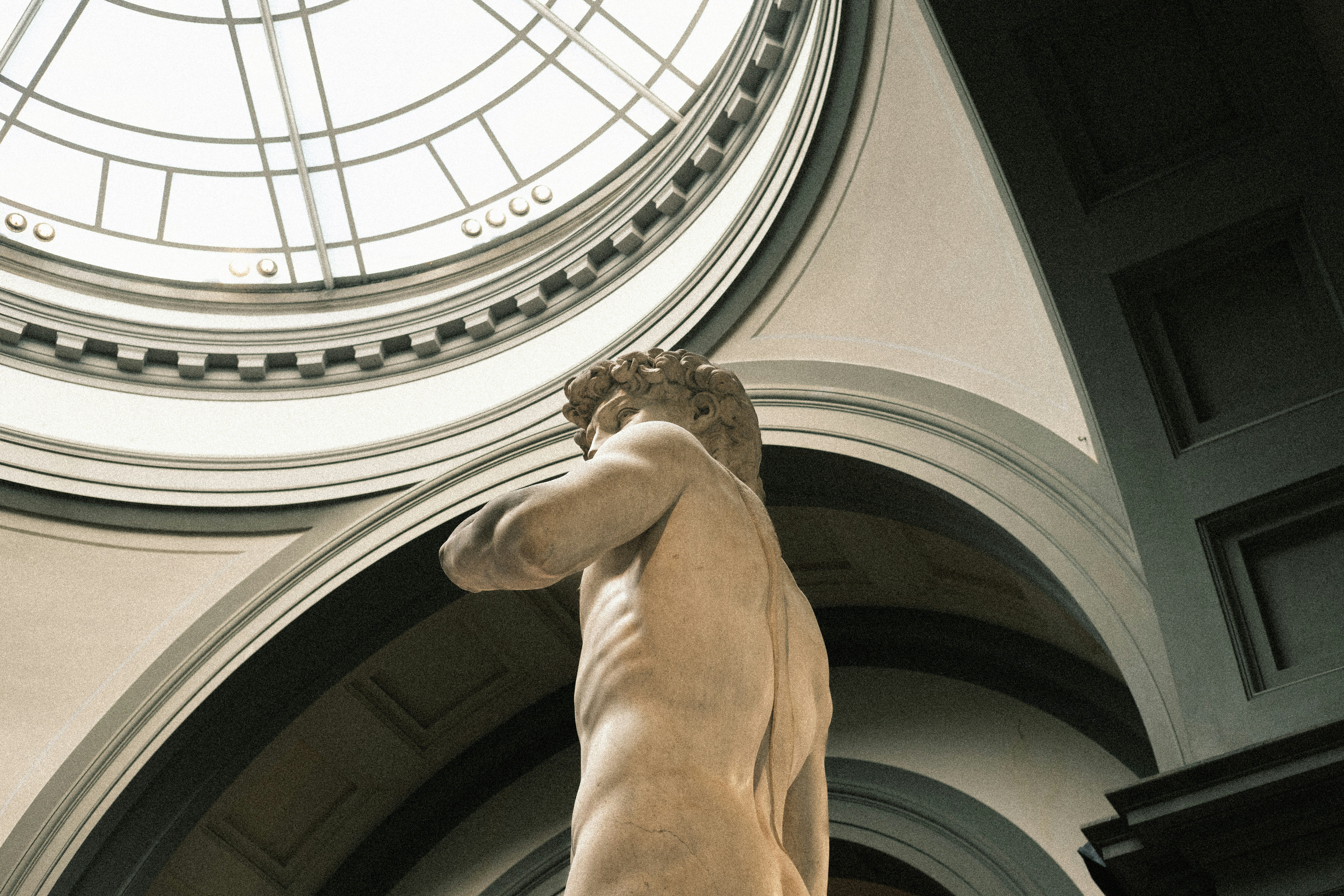
We might push against the material of our lives, but it will most certainly push back at us. We form our thoughts, actions, and character not in a vacuum, but in response to circumstances that have their own requirements. “There is always an exchange with worked material,” Bardt observes; “It is first an exchange of action and reaction, but ultimately it becomes an exchange that binds material and author” (p. 218). In the push and pull of life we are both producer and product, artist and artwork. Like Michelangelo working with the veining of a block of marble—not against it—we will be more successful if we skillfully respond to material conditions. Herein lies the artistry: knowing exactly where to strike the chisel.
All too often Stoicism is thought of as an unyielding philosophy, and Stoic self-sufficiency is represented as either detaching from the world or forcefully imposing your own will on it. However, I don’t think this view accurately represents the Stoic position. What’s often overlooked is the attentive receptivity required to skillfully respond to circumstances. There are certainly times when it’s necessary to be strong and steadfast, but this is only part of the story. What matters is our attunement to the context—our sensibility to the signals coming back to us from the people and things around us.
Thinking of ourselves as artists working with the material of life draws our attention to the creative receptivity required for wisdom and virtue. Good artists work in concert with their raw material—beginning with a vision, yes, but flexibly adapting that vision during the process of creation:
All materials, each in its own particular fashion, meet our actions, resist them, transform them, and reflect new possibilities back at us, and in doing so bring our volition into a process of imagination and creativity.
Material and Mind, p. 32
This concept—creative volition—seems remarkably Stoic to me. Marcus Aurelius says much the same thing in Meditations 4.1:
When the ruling power within us is in harmony with nature, it confronts events in such a way that it always adapts itself readily to what is feasible and is granted to it. For it attaches its preference to no specific material; rather, it sets out to attain its primary objects, but not without reservation, and if it comes up against something else instead, it converts it into material for itself, much like a fire when it masters the things that fall into it. These would have extinguished a little lamp, but a blazing fire appropriates in an instant all that is heaped on to it, and devours it, making use of that very material to leap even higher.
We can easily get caught up in a specific vision of “the way things should be,” whether that applies to ourselves, other people, or even the place we live (community or country). But the universe has a funny habit of not doing what we want it to—it rarely cooperates with our visions of perfection. To be truly effective we need to learn how to use whatever material is on offer, even if it’s far from perfect. We creatively work with, around, and through the flaws in our material, perhaps adapting our original plan in response to current circumstances. In the face of challenges, we become more innovative, not less.
So rather than trying to single-mindedly impose our will or vision on the world, let’s think in terms of creative volition: how can we express ourselves and accomplish our goals in response to the existing material of life? We will certainly meet with resistance, but this is simply part of living in a physical world. Our goal should be to handle it with a deft touch. In the beautiful words of Marcus Aurelius (Meditations, 10.33):
Given the material that is granted you, what is the soundest thing that can be done or said? For whatever that may be, it is in your power to do or say it, and you should not try to excuse yourself by saying that you are being prevented…For you should regard as an enjoyment all that you are able to accomplish in accordance with your own nature; and everywhere that is within your reach.
Photo credit: Jonah Townsley via Unsplash
Beautifully written, Brittany.
Beautifully put, Brittany. Seneca was very much in tune with thinking about materials, creation, shaping - in Letter 65, he investigates cause, matter, the form imposed by the artisan according to the concept in his mind - completely a Stoic preoccupation.