
Arrian, Stoic Role Model
Let's pause to appreciate an overlooked philosopher
Who was Arrian, really? We frequently gloss him as the student scribe who wrote down Epictetus’ Discourses, perhaps giving him a brief nod of thanks before passing on to study the teachings of Epictetus. But maybe we should be more curious about Arrian himself. After all, it was Arrian’s initiative to write down the words of his master, and Arrian’s own memory and writing abilities, that enabled Epictetus’ philosophy to be widely disseminated in ancient times and passed down to our own. Arrian selected which dialogues and topics to record, and he did a good enough job at reproducing Epictetus’ greatly admired rhetorical style that he earned the praise and lifelong respect of his contemporaries.
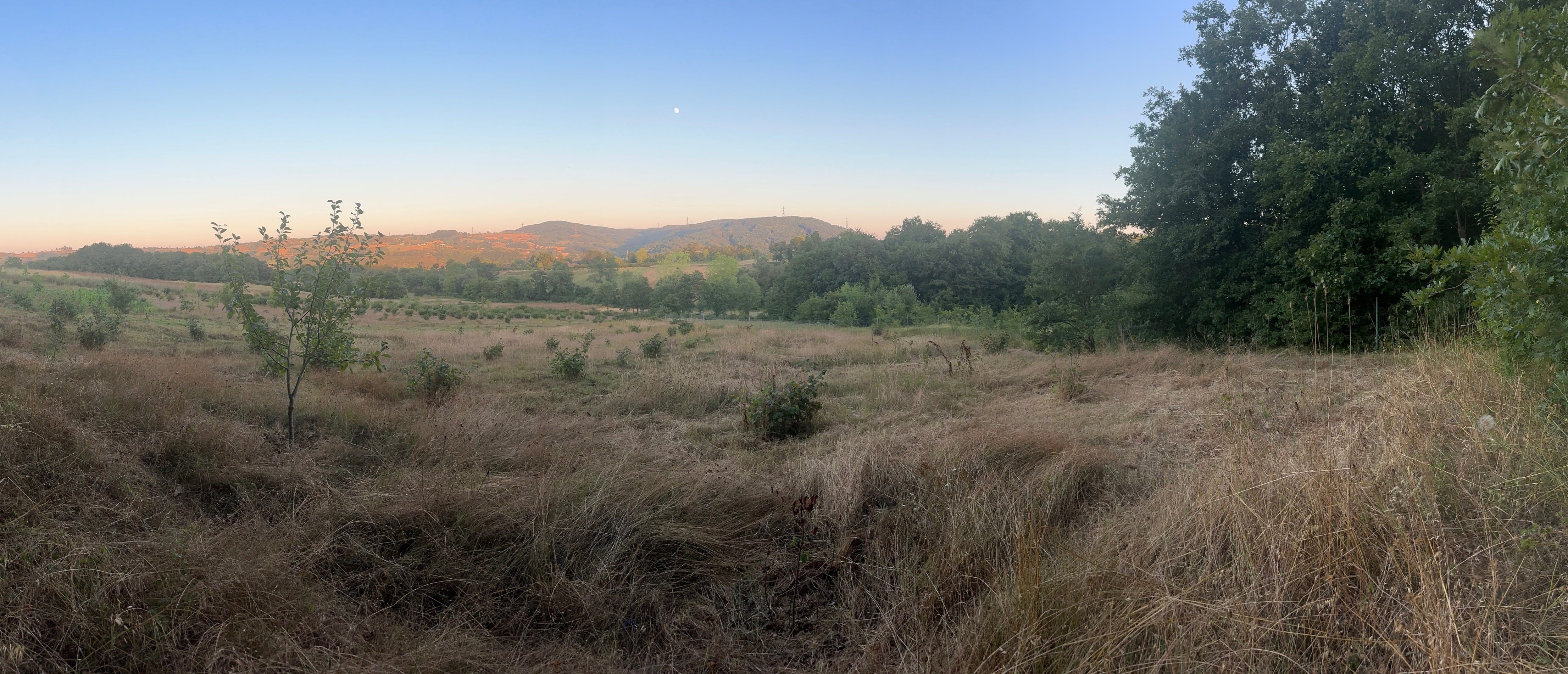
I’ve been thinking a lot about Arrian over the past few years, and not just because I love Epictetus so much. My in-laws live in the countryside near Izmit, Turkey, where Arrian was born. (The town was known in Greco-Roman times as Nicomedia, and the surrounding province was Bithynia.) The land around there is breathtakingly beautiful. Izmit is in a valley beside a marine inlet, and the surrounding mountains are almost perfect: vast and impressive, but also gently rolling and not intimidating. Arrian loved hunting around there, and I can see why. My family loves to spend hours walking over the mountains, which today are mostly farmland but in his time were likely wooded. It’s the ideal place to be outside and roam widely, with beautiful vistas confronting you in every direction, and cooling summertime breezes blowing in from the Black Sea to the north. While winters are frigid, the beauty of the landscape more than makes up for them. I think anyone living here would learn to love nature.
Arrian was very proud of his homeland, as evidenced by his writing a deferential history of Bithynia during his retirement. But he was also a Roman citizen, and he reached the highest heights of Roman achievement: military officer, consul, and governor of the border province of Cappadocia, which required both intelligence and diplomatic skill. He was trusted and respected by the emperors Trajan and Hadrian, and in later life, after retiring from imperial service, he became a leading citizen of Athens and was granted the highest honor in town (eponymous archon). Everywhere Arrian went he seems to have been recognized for his honorable character, governing abilities, and literary and philosophical accomplishments.
In other words, Arrian seems almost to be a sage-like figure. He was a man of both action and reflection, a respected military strategist and imperial legate who also wrote historical and philosophical works. Not only did he record Epictetus’ Discourses during his youth, but he wrote numerous other works throughout his life: treatises on hunting, atmospheric phenomena, and historical works on Alexander and other figures. He was what we today would call a Renaissance man—though of course the Renaissance men were themselves looking back to ancient exemplars like him.
I think it’s high time we give Arrian his due and think about him as a Stoic in his own right, not just as amanuensis of Epictetus. The difficulty is that we know so little about him. If you want to learn about Arrian, there are very few good sources. The best one I could get my hands on is a 1980 monograph by Philip A. Stadter, Arrian of Nicomedia. It’s an excellent book, thorough and insightful, both scholarly and clearly written. I would highly recommend it to anyone keenly interested in Arrian’s life and work.
One quick caveat, though: the bulk of Stadter’s book is focused on Arrian’s military/historical writings, which is what he has gained greatest recognition for over the centuries. I’m not terribly interested in this aspect of his writing, but I do think it’s important to consider them in order to get a full picture of his life. As we know, philosophy as a way of life concerns the whole person and everything they do, not just selected bits and pieces. According to Stadter, Arrian’s historical writings also reveal quite a bit about his character, so it’s certainly worth learning about this aspect of his legacy as well.
With that said, let’s explore Arrian’s life as described in Arrian of Nicomedia.
Arrian was a Greek in a Roman world. He came from an aristocratic Greek family who had (probably, though not certainly) been granted Roman citizenship in previous generations. Arrian himself came of age at a time when the Roman emperors were trying to integrate the Greek communities of Asia minor, which had always stayed as aloof as possible from Roman politics and imperialism. (According to Stadter, both the Greeks and Romans knew Greek culture was superior and had been co-opted by the Romans, who wanted to seem sophisticated but weren’t fooling anyone.) Arrian was among the first of Greek heritage to become a Roman consul and governor. This dual identity was a key part of his life, career, and literary accomplishments.
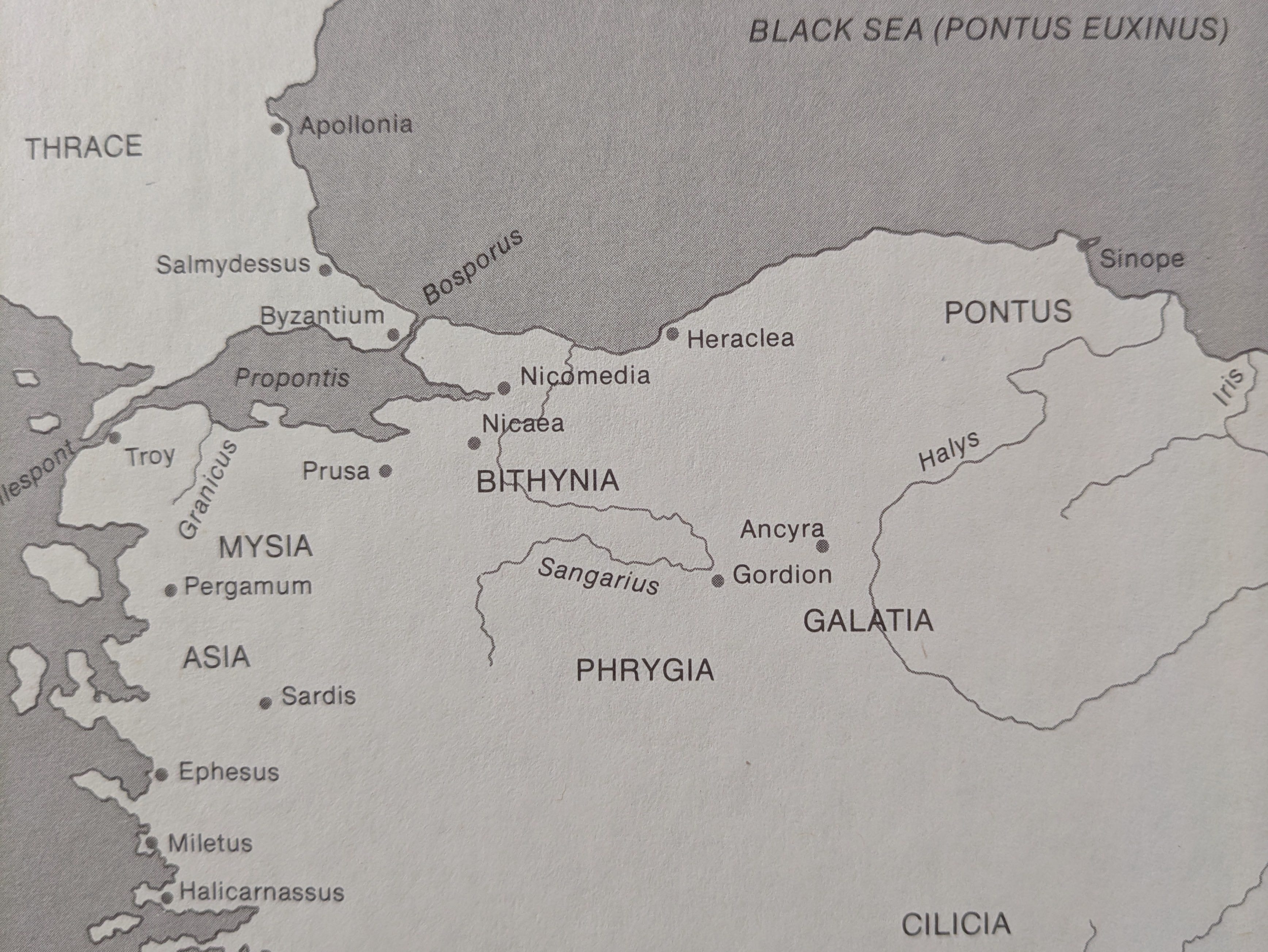
It’s interesting that although Arrian did so well within the Roman military/ government hierarchy, he remained firmly connected to his Greek identity: “When he decided to write the history of his own country,” Stadter tells us, “he wrote on Bithynia, not on Rome, and the work belongs to the tradition of Greek local history, not res populi Romani domi militaeque gestae” (p. 1-2). Even his name—Lucius Flavius Arrianus Xenophon—probably set the tone for his life’s work. Stadter notes that although Xenophon was a common enough name among Greek speakers, it could indicate a special interest in philosophy on the part of his parents. And once Arrian began writing about philosophy, others around him explicitly connected his work to that of his namesake. (Xenophon was a student of Socrates who recorded his teacher’s words and deeds in works such as Memorabilia, Symposium, and Apology.) Perhaps this connection explains why, “despite the presence of such a well-known figure as Dio Chrysostom in Bithynia, and famous schools in the neighboring province of Asia and in Athens, Arrian chose to travel to the town of Nicopolis, on the northwest coast of Greece, to study philosophy with an ex-slave exiled by Domitian, the Stoic Epictetus” (p. 4).
Although we don’t know why Arrian chose to study with Epictetus, we do know that “the impression made by Epictetus himself was unforgettable” (p. 5). It’s possible that Arrian stayed in Nicopolis up to two or three years, and at some point along the way he decided to write down his teacher’s words. His exact reasons for doing so remain unknown, but we can certainly guess:
We know Epictetus’ pupils exercised themselves by writing philosophical dialogues in the style of Plato, Antisthenes, or Xenophon. We can imagine the young Arrian deciding instead to attempt, on the basis of notes and memory, to capture the exact flavor of Epictetus’ teaching style for his own use, and incidentally to imitate the writers of Socrates’ dialogues much more genuinely than by a scholastic dialogue in the Attic dialect.
(p. 27)
Whatever his motivations, it’s important that Arrian decided to record Epictetus’ teachings in the everyday language of Koine Greek. He could have tried to stylize them into the more formal language of Attic Greek, which was generally how philosophical and literary works were written at the time. This might have been an especially tempting option for someone named Xenophon, who probably saw himself as following in the footsteps of Socrates’ protégé. But it would have been like someone today writing their class lecture notes in the style of Shakespeare—inauthentic and probably not doing justice to Epictetus’ punchy rhetoric. As Stadter notes, “Arrian rejected the simple and servile imitation of Xenophon’s dialect to achieve a more real imitation, following Xenophon in reporting the words of his master in the language in which he spoke them” (pp. 166-167).
It’s possible that Arrian was simply recording notes for his own later use or for some close friends, rather than intending them for wider publication. This is what he later wrote to his friend Gellius (in a letter that now usually serves as a preface to the Discourses). Perhaps he was able to record everything in such detail by using shorthand, but Stadter suggests this is unlikely; shorthand was normally used by professional scribes, and a person of Arrian’s social status would probably not have known it. This has led some scholars to suggest that Arrian liberally reconstructed his master’s dialogues, and that the Discourses owe more to Arrian than to Epictetus. But Stadter and most other scholars reject the view that Arrian wholly recreated his teacher’s conversations. Arrian doesn’t claim to have recorded Epictetus’ teachings word for word, but somehow he was able to capture the flavor and message of the great philosopher. Therefore “we must assume that the work as it stands reflects Arrian’s own interests, as he took notes or recalled the talks afterwards, selecting what seemed to him especially important or striking” (p. 27).
It seems that Epictetus’ words became popular almost as soon as they were written down. (He was already a famous and sought-after teacher, so this is no surprise.) Though Arrian never formally published the Discourses, he must have lent his notes out to friends, who copied them down and then shared with their friends, who copied them down, etc. Soon the discourses were in wide circulation, and they brought Arrian recognition and philosophical fame:
The importance of Arrian’s record of Epictetus’ lectures for his contemporaries, as indicated by their interest in copying his text, in large part explains the title “philosopher” which he was frequently given. The influence of the book was felt at once, and prominent figures such as Herodes Atticus and [Arulenus] Rusticus, both of whom had copies of the book, were probably his friends.
(p. 29)
Arrian later—perhaps due to popular demand—picked out some of the key teachings from the Discourses and included them in the much shorter Enchiridion (translated as Manual or Handbook), a fact that Stadter notes “provides additional evidence that his interest in the philosopher’s teaching was more than passing” (p. 29).
But while being known as the editor of the Discourses gave Arrian’s literary career (and probably his military career as well) a boost, it didn’t end there. He continued to write throughout his life. It’s possible he primarily wrote his other books during his retirement in Athens, but Stadter suggests he was able to continue his scholarship even as a military commander and governor. One potential clue comes from a lost philosophical treatise Arrian wrote on meteorological phenomena (specifically on “comets…the cause of thunder and lightning, the nature of mist, dew, frost, and snow, and the interrelations of winds tides and the moon” [p. 30]). At the time, of course, the physical sciences were part of philosophy, and many philosophers researched and wrote about these topics. So it would not be at all unusual for Arrian to address them as well. However, the manner in which he did so was particularly Stoic, and particularly Epictetan:
According to Photius “Arrian in writing his pamphlet (biblidarion) on the nature, composition, and appearances of comets, tries to show that this kind of prodigy portends nothing either for good or evil.” The notice supplies a title, On the Nature, Composition, and Appearances of Comets, and indicates that the purpose of the work is philosophical and ethical. To maintain the kind of spiritual autonomy urged by Epictetus in the moral sphere, it was necessary to have a proper attitude toward occurrences in the natural world.
(p. 30)
What’s especially suggestive about this is the potential connection with Arrian’s military career:
The ancients were notoriously superstitious about comets, and soldiers especially considered them ominous. A comet appeared in November 115, and might have discouraged Roman troops fighting the Parthians, and even given pause to their commanders. Arrian probably took part in this Parthian expedition and may have written at this time a work reviewing the rational explanations for the startling phenomenon.
(p. 30)
I think it’s incredibly interesting that Arrian may have been using Epictetus’ method to help calm his soldier’s fears—a perfect example of practical philosophy in action. If this is true, it’s a remarkable illustration of Arrian’s lifelong commitment to Stoic principles, and attests to the lasting impact of Epictetus’ teachings on his students. It’s very gratifying to think that the compiler of the Discourses practiced what he preached.
There is further evidence that Arrian applied Stoic teachings to his military and literary achievements more broadly. As I’ve already noted, he wrote quite a few works of military strategy and history, but he did so in an independent (i.e., non-obsequious) spirit. I’m quoting Stadter at length here, partly because I’m not very knowledgeable about military things but also because he so aptly sums up Arrian’s philosophical way of life:
Epictetus, with his teaching on the freedom of the individual and the duty to assign values not on the basis of outside pressure but according to one’s own judgment, found in Arrian a willing pupil, but one who did not allow his philosophy to hinder his progress in a senatorial career. As with Xenophon, philosophy was a facet, not the focus of Arrian’s life. Nevertheless, the Discourses and the Manual are not simply the youthful expressions of esteem for a master forgotten in later years. The statues erected at Corinth and at Athens to Arrian the philosopher indicate that there was something in his life which distinguished him from his contemporaries, and in his nonphilosophical writings we find clear indications of the permanent effect of Epictetus’ words. We have noted the Epictetian language of the epigram from Cordoba, and the gracious yet independent and far from sycophantic tribute paid to Hadrian in the Periplus and Tactics. Apparently even in the Parthica, as he narrated the conquests of Trajan, Arrian reminded his reader that human power had limits, that the conqueror would die despite his success, and that conquest could never be an absolute goal. The Anabasis is a moral as well as a military history, written by one aware of the insidious snares that enslave the powerful—flattery, the sense of being without limit in one’s actions and desires, the notion that the power to kill is the power to rule…To him what was accomplished was less important than the moral integrity of the men who accomplished. Nevertheless, how admirable and worthy of praise was one who could achieve great deeds with integrity!
(pp. 165-166)
What a compelling tribute, both to Arrian and to his teacher. Arrian was able to successfully navigate a military/political career amongst power-hungry and status-conscious Romans, while also exercising his love of philosophy and apparently maintaining his personal integrity. Not only did he record Epictetus’ Discourses for posterity, he lived by them. While he was gifted many advantages in life—his social rank, his opportunity to study with Epictetus, his well-connected benefactors—he was also capable, savvy, and honorable in his own right. “In the world of the second century AD,” Stadter observes, “Arrian stands out as a complex and remarkable figure” (p. 164).
For us today, I think Arrian can serve as a strong role model. Even though we must speculate a bit, it seems clear that he approached his worldly ambitions with Stoic integrity. I think this is valuable as we look for models for our own lives. The most famous Roman Stoic with both literary and political ambitions—Seneca—led a complicated life and can be criticized for failing to live up to his principles. I suppose Arrian was lucky that he worked for Trajan and Hadrian rather than Nero, and of course he wasn’t nearly as high-ranking or powerful as Seneca at his zenith. However, Arrian still seems like an interesting counterpoint to Seneca, and perhaps a more realistic model for those of us who don’t live with emperors (and are not emperors ourselves). Arrian lived a productive life, handled his challenges skillfully, was respected by his friends and colleagues, and seems to have done good in the world. What more could we ask? That sounds like success to me.
While Arrian may not have been a professional philosopher, he certainly qualifies as a philosopher in the broader sense: someone who lives by their philosophical principles. And this, Epictetus tells us repeatedly, is what really matters.
A builder doesn’t come forward and say, “Listen to me as I deliver a discourse about the builder’s art,” but he acquires a contract to build a house, and shows through actually building it that he has mastered the art. And you for your part should follow a similar course of action: eat as a proper human being, drink as a proper human being, dress, marry, father children, perform your public duties; put up with being abused, put up with an inconsiderate brother; put up with a father, a son, a neighbor, a fellow traveler. Show us these things to enable us to see that you really have learned something from the philosophers.
Discourses, 3.21, 4-6
Thank you, Epictetus, for the wise words. And thank you, Arrian, for writing them down.
Love this Brittany- so glad to see this unsung hero getting his due- a truly inspiring figure captured in a great essay- thank you!
Hear, hear! Thanks, Brittany, for reminding us about Arrian the man, and his context - and the local information about Bithynia was very welcome too.