
Summer is in full swing, and if you’re like me, you never head to the beach or travel without a good book. During our recent road trip around Sicily I was reading Mary Beard’s new book, Talking Classics: The Shock of the Old. Beard always has interesting things to say, but I’m not sure there’s a lot of new material here if you’ve already read her previous works. Still, it was nice to reflect on the enduring legacy of ancient Greek and Rome while wandering through ruins in Siracusa and Agrigento. (Pictures are at the end of the post!)
Here are a few other books I’ve read lately that I would recommend for those interested in philosophy and psychology. I hope you all enjoy your summer, whether you’re relaxing at home or on the road.
How to Be a (Happy) Skeptic: The Power of Doubt in a Meaningful Life
Massimo Pigliucci
It’s unfortunate that Cicero—who for hundreds of years was one of the most revered philosophers of the Western canon—is now neglected by academic philosophers and casual readers alike. Massimo Pigliucci’s most recent book aims to rectify this oversight by providing an accessible overview of Cicero’s life and works. Like all Pigliucci’s books, this one is comprehensive and very readable, drawing on his background as a scientist and philosopher to address the major questions of life: how do we know what we know? how do we build a just society? how do we face aging and death?
Like Cicero himself, Pigliucci is a Stoic-influenced Skeptic, so this account draws heavily on Stoicism with a dose of Skeptism in the epistemological sections. The power of doubt is discussed primarily in the first two chapters, while the majority of the book is devoted to topics like citizenship and friendship. For me that is a positive, as Cicero offers insightful discussion of these themes (and is one of the major surviving sources of Stoic theory). Readers who are not already familiar with Cicero will come away with a thorough grounding in the life, times, and work of one of the most influential figures of the ancient world. Understanding Cicero is essential for anyone interested in Stoicism or ancient philosophy, and this new book is a great place to start.
The Character Sketch as Philosophy: Manners, Mores, Types
Katie Ebner-Landy
The Aristotelian philosopher Theophrastus, among his many other contributions to philosophy, wrote a series of character sketches skewering the vices he saw in Athenian society: the flatterer, the boor, the gossip, etc. These witty and succinct sketches were avidly read for the next two thousand years, inspiring many later translations and copycat sketches. In this engaging book, Ebner-Landy explores the enduring influence of Theophrastus’ character sketches, giving us a glimpse into the intellectual history of this genre through the Renaissance and early modern period.
From a Stoic perspective, I have mixed feelings about the Theophrastan character sketch. On the one hand, it encourages virtue by showing how ridiculous vice is; no one wants to be like the unappealing men in these vignettes. (And yes, they are all men, a fact that Ebner-Landy addresses as well.) On the other hand, the sketches are rather superficial. As Ebner-Landy puts it,
No sketch is longer than fifteen sentences. Each vice is described from afar, with the sketches rarely considering a type’s motivations or intentions. There is no other system beyond this three-part formula of unquestioned statement, detailed description, and final judgement: no reasoning, explanation, argument, or rebuttal. (p. 3)
The ancient Stoics, in contrast, devoted quite a bit of thought to deeper analysis of character and motivations. For example, Chrysippus closely analyzed the actions and intentions of Medea—the famous Euripidean character who kills her children to spite her ex-husband—declaring that even she is a candidate for moral rehabilitation. The Stoics offer a much more nuanced picture of character psychology than Theophrastus, as well as a belief in the power to change that is lacking in the. It’s one thing to make fun of foolish people, but another to try to understand and help them. For these reasons, I think the Stoics improved upon the Theophrastan character sketch.
However, none of that takes away from Ebner-Landy’s excellent work here. She very comprehensively covers the centuries-long response to Theophrastus, adding her own insights into why his work was received in different ways in different times. And she makes a good case for bringing the character sketch back into Serious Philosophy. I would recommend the book for anyone interested in the history of philosophy or virtue ethics—it’s a fascinating tour through the intellectual fashions of the past two and a half thousand years.
Sick Souls, Healthy Minds: How William James Can Save Your Life
John Kaag
I’m a fan of John Kaag’s work—I’ve previously covered his book American Philosophy: A Love Story—and I really enjoyed this intellectual biography of William James, one of the giants of American philosophy and psychology. Here we get up close and personal with James’ inner demons, from his strained relationship with his father to his ongoing struggle with suicidal thoughts. We see him fall in love, marry, and establish his illustrious career; we witness the birth of the philosophical system that would become known as pragmatism. James’ accomplishments were extraordinary, and Kaag does full justice to his remarkable personality as a thinker, teacher, husband, and friend.
The book’s subtitle, How William James Can Save Your Life, refers to James’ personal decision to live life even when he wasn’t sure it was worth living. As Kaag puts it, “William James’s entire philosophy, from beginning to end, was geared to save a life, his life” (p. 3). But Kaag also doesn’t disguise the fact that James’ philosophy has helped save his own 21st century life—“or, more accurately, it encouraged me not to be afraid of life”:
James wrote for our age: one that eschews tradition and superstition but desperately craves existential meaning; one that is defined by affluence but also depression and acute anxiety… To such a culture, James gently, persistently urges, “Be not afraid of life. Believe that life is worth living, and your belief will help create the fact.” (p. 5)
Even if James and Kaag are ultimately ambivalent about the objective value of life, the book leaves us in no doubt that we should proceed as if life has great meaning. By acting as if something is wonderful, we make it so. In fact, “one should act before one knows the answer” (p. 59) in any number of contexts, including friendship and love. While James was lucky in love, Kaag has not fared so well, and he can’t help but compare romance to life in general:
Over the years, I have come to believe that there is something deeply, if not divinely, right about situations that require James’s will to believe. Being in love is not like falling from a great height, or, as the theologian Thomas Merton writes, like tripping into a deep pool. It is not passively experienced. It involves a free act, with one eye open, that can, and usually does, transform a life for better or for ill, for richer or for poorer. Love’s conditions are partially up to you. This means that you have the power to effect a romance, but are also fated to be effected by it. Remember: partially up to you. If love were fail-safe or prearranged, it wouldn’t mean nearly so much when it survives.
While this book doesn’t offer pat answers to life’s deepest problems, it does offer a worthwhile discussion between James and Kaag—with James proposing answers and Kaag dissecting them in light of today’s culture and science. I would recommend this to anyone interested in William James or an existential perspective on life. It will certainly give you much to think about.
Conflicted: How Productive Disagreements Lead to Better Outcomes
Ian Leslie
Have you ever disagreed with someone before? Silly question, I know—we have all disagreed with someone else at some point. Disagreement is a part of human life. So here’s a different question: have you ever disagreed well? This opens up a whole new way of thinking about conflict. Disagreements may be inevitable, but that doesn’t mean they have to be bad. In fact, as Ian Leslie argues in Conflicted, disagreement can actually be healthy and helpful. The key, of course, is doing it well.
Throughout the book he offers many examples of expert negotiators and the techniques they use to turn disagreements from a battleground into an arena for cooperation. Some are quite high-stakes, as in the discussions between Nelson Mandela and Constand Viljoens during the fall of apartheid in South Africa, or police officers successfully obtaining information from suspects during questioning. Others are more light-hearted. One of my favorite examples is the brotherly bickering between Orville and Wilbur Wright as they created the first working airplane. Though their back-and-forth was incessant, Leslie suggests that their extremely strong bond allowed them to take disagreement in stride and build on each other’s suggestions—thereby beating the competition to become first in flight.
This is the underlying theme of Conflicted, borne out by countless historical examples, the advice of conflict gurus, and Leslie’s deep research: good disagreements depend on good relationships. Not every disagreeable encounter will take place between people who have an existing relationship; but every skilled disagreer creates an opportunity to build rapport even with someone they have just met. And for disagreers who have a history of contention, or who have fallen into a stalemate, he recommends shaking things up through humor or a change of perspective. Whatever it takes, the Golden Rule of disagreement is always to “make an honest human connection.” When people feel respected and listened to, we are all much more likely to cooperate.
At the end of the book, Leslie provides a handy “toolkit of productive argument” that summarizes his main themes, including points like resist negative reciprocation and stop trying to be right. Of course, these things are easier said than done, but the first step is to have a good working knowledge of best practices, which this book certainly provides. I think Conflicted would be useful read for pretty much anyone. Disagreement in some form is a part of every human life, so we may as well deal with it in the best way possible. As Leslie puts it (p. 249):
The best disagreements…neither reinforce nor eradicate a difference, but make something new out of it. Persuasion is a noble and necessary art, and I like it when I make someone think again, but my ultimate aim is not to get you to agree with me. I want your thinking to improve my thinking; your experience to modulate and enrich my own. I want us to disagree creatively: to make something new and better out of our diverse opinions than either of us could have conceived of alone. That way we both win.
Photos from Sicily
I have been awaiting a letter from you, that you might inform me what new matter was revealed to you during your trip round Sicily…
Seneca, Letters on Ethics, 79.1
Sicily is a world unto itself. My family and I recently had a chance to make a brief tour of the island, and we absolutely loved the ancient sights, the natural beauty, and, of course, the delicious food. There’s so much to do, you have to be selective if you only have a week to travel, like we did. We began outside Catania, where we got to climb Mount Etna—a truly impressive presence looming over the whole Eastern half of Sicily. (We could see it 70 miles away—maybe more!) I got up early one morning to take pictures from our balcony of the sun coming up over Etna.
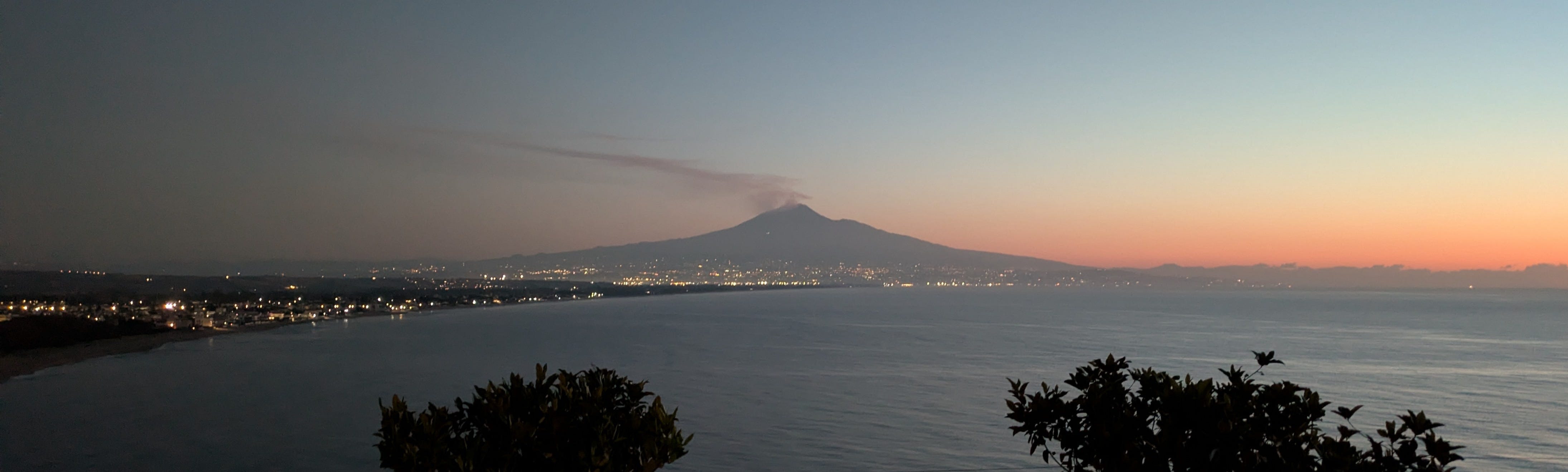
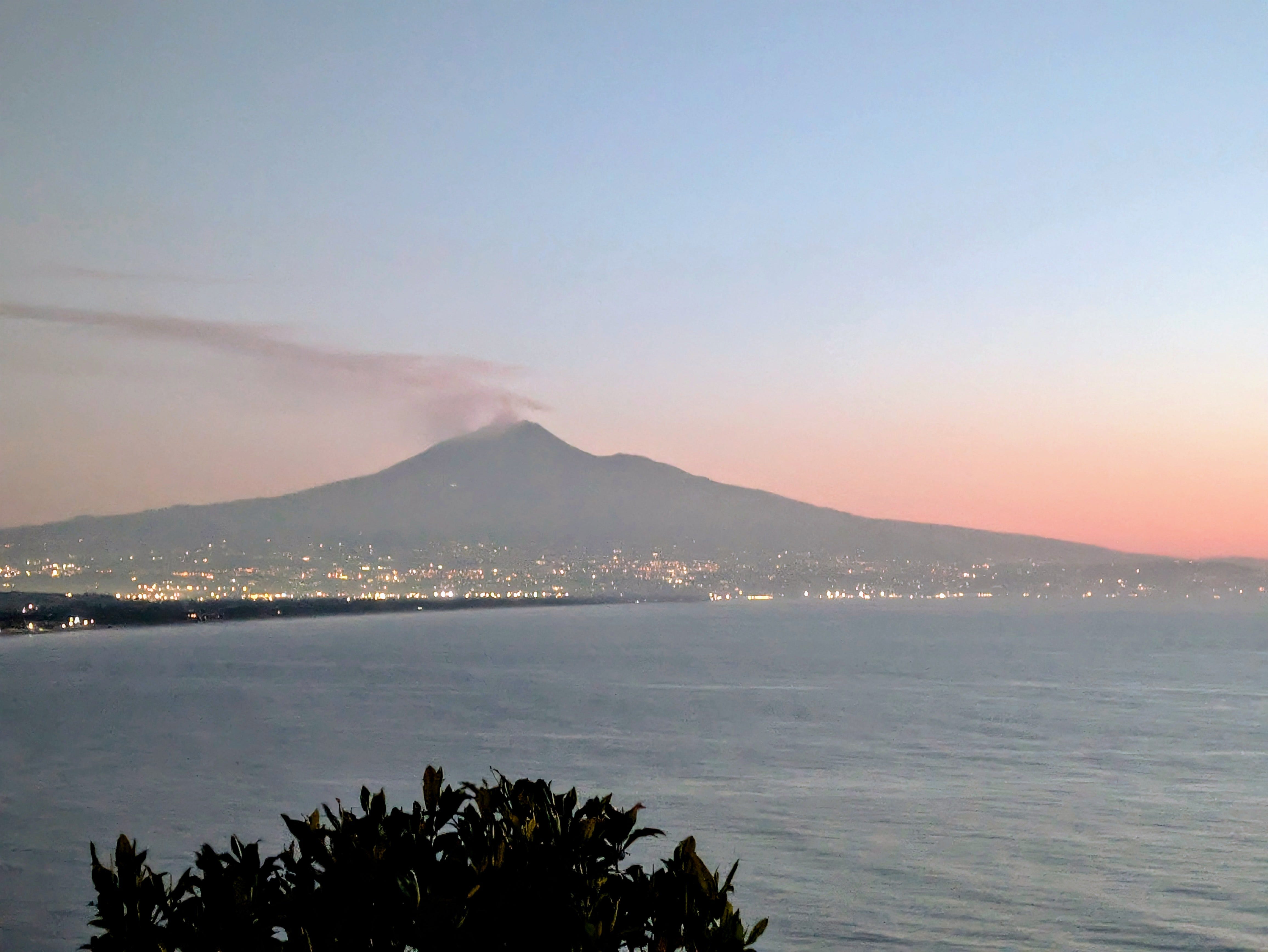
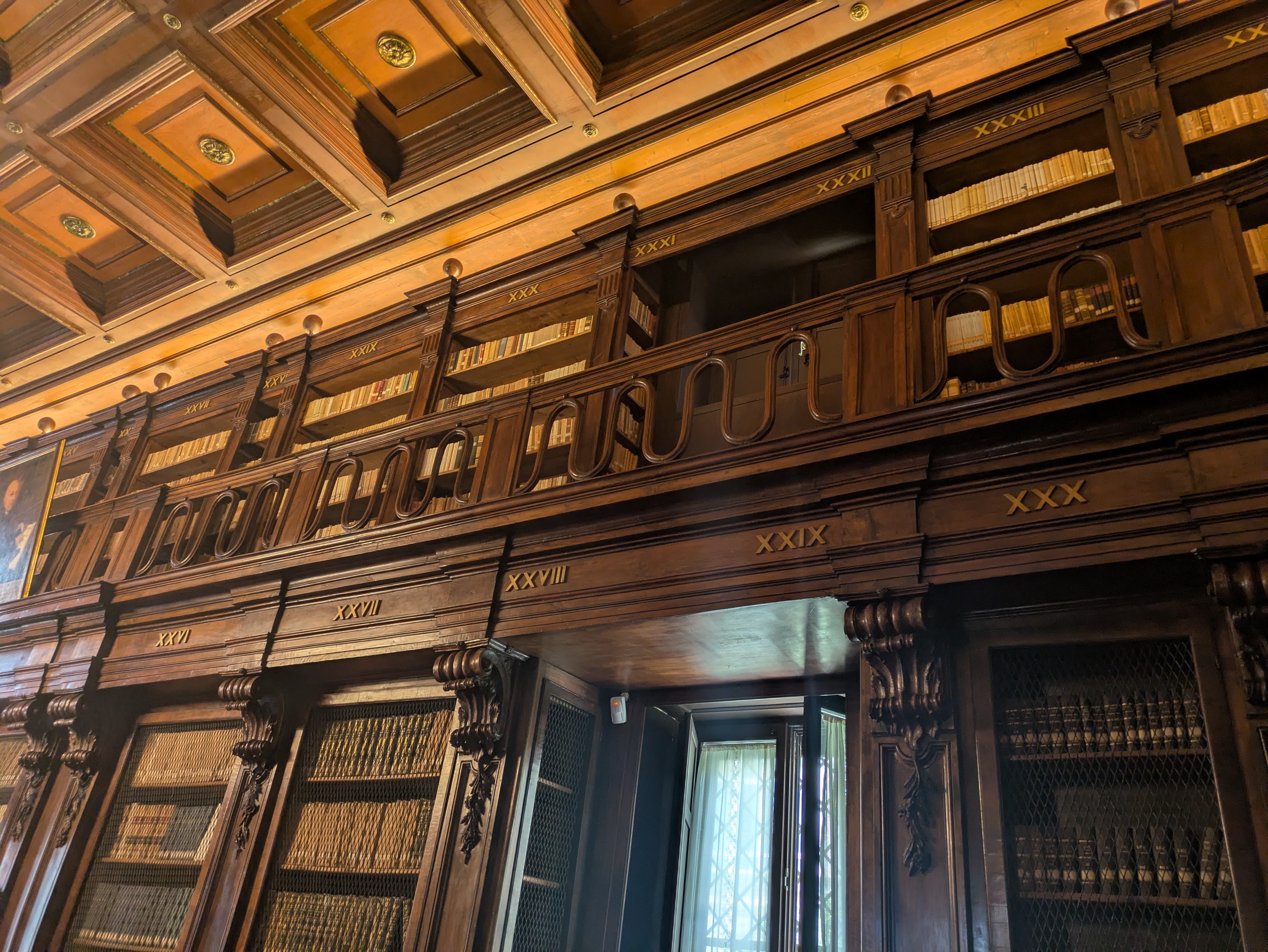
We also had a chance to visit Siracusa, where we saw the Greek theatre and so-called Ear of Dionysus (you can read the history of this cave here). But my favorite place in Siracusa wasn’t ancient—it was the Renaissance library in the bishop’s palace.
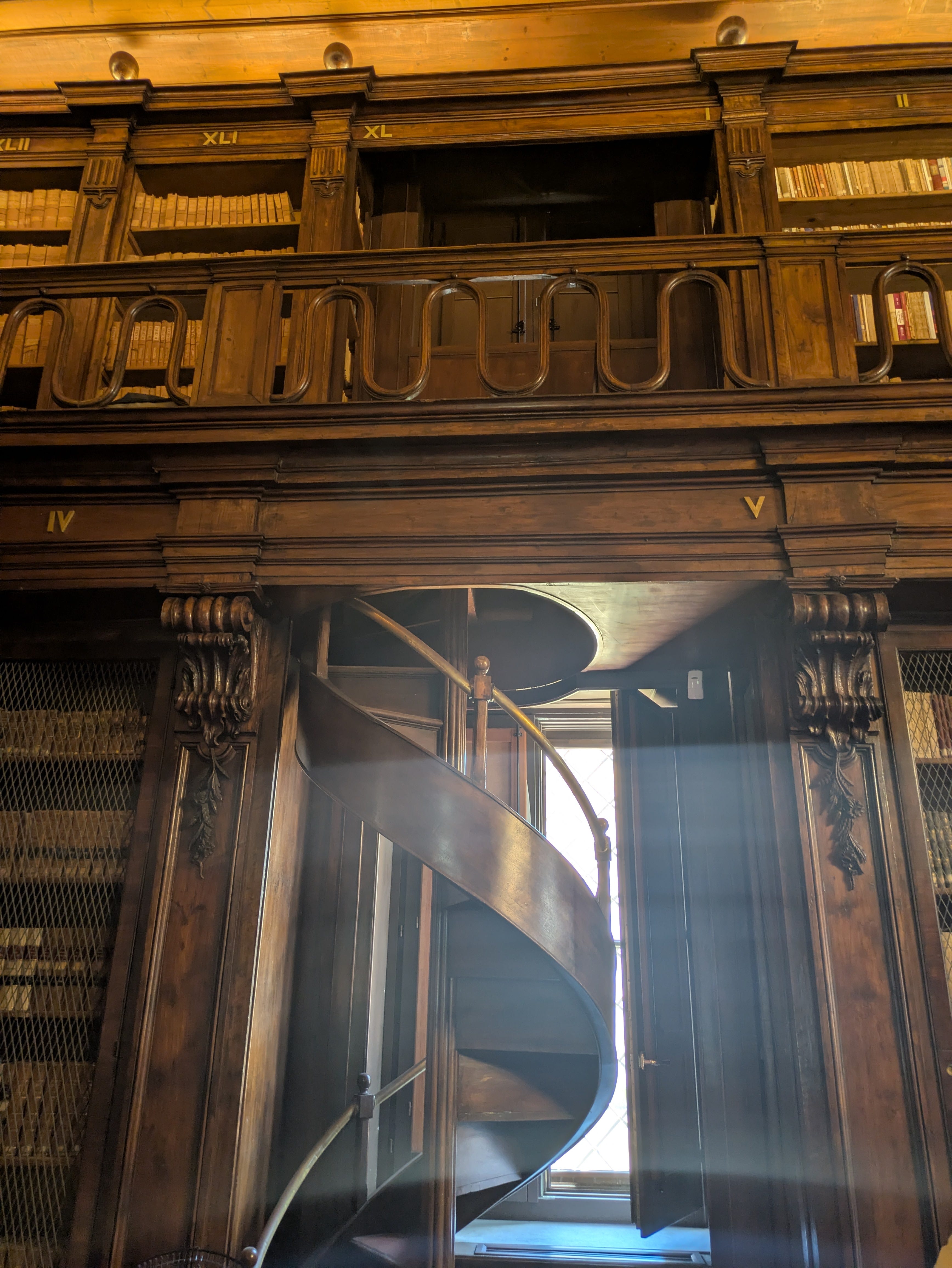
Please excuse the bad backlighting on the next photo—I’m not a great photographer so I just snap pictures without adjusting the exposure. Anyway, it kind of adds to the mystique of the spiral staircase!
Next we stopped at Villa Romana del Casale, which is one of the most unique ancient sites I’ve ever visited. It’s a palatial residence probably built by a wealthy merchant in the 4th century, and fortunately for us it was preserved under a mudslide and then rediscovered in the 19th century. The entire palace complex features stunning mosaics on the floors, some of them perfectly preserved. The most impressive is the hall of the great hunt, 60 meters long and featuring exotic animals from Africa. There is also the famous “bikini girl” mosaic showing Roman women exercising, and many others. My family thought this was the most impressive ruin in Sicily.
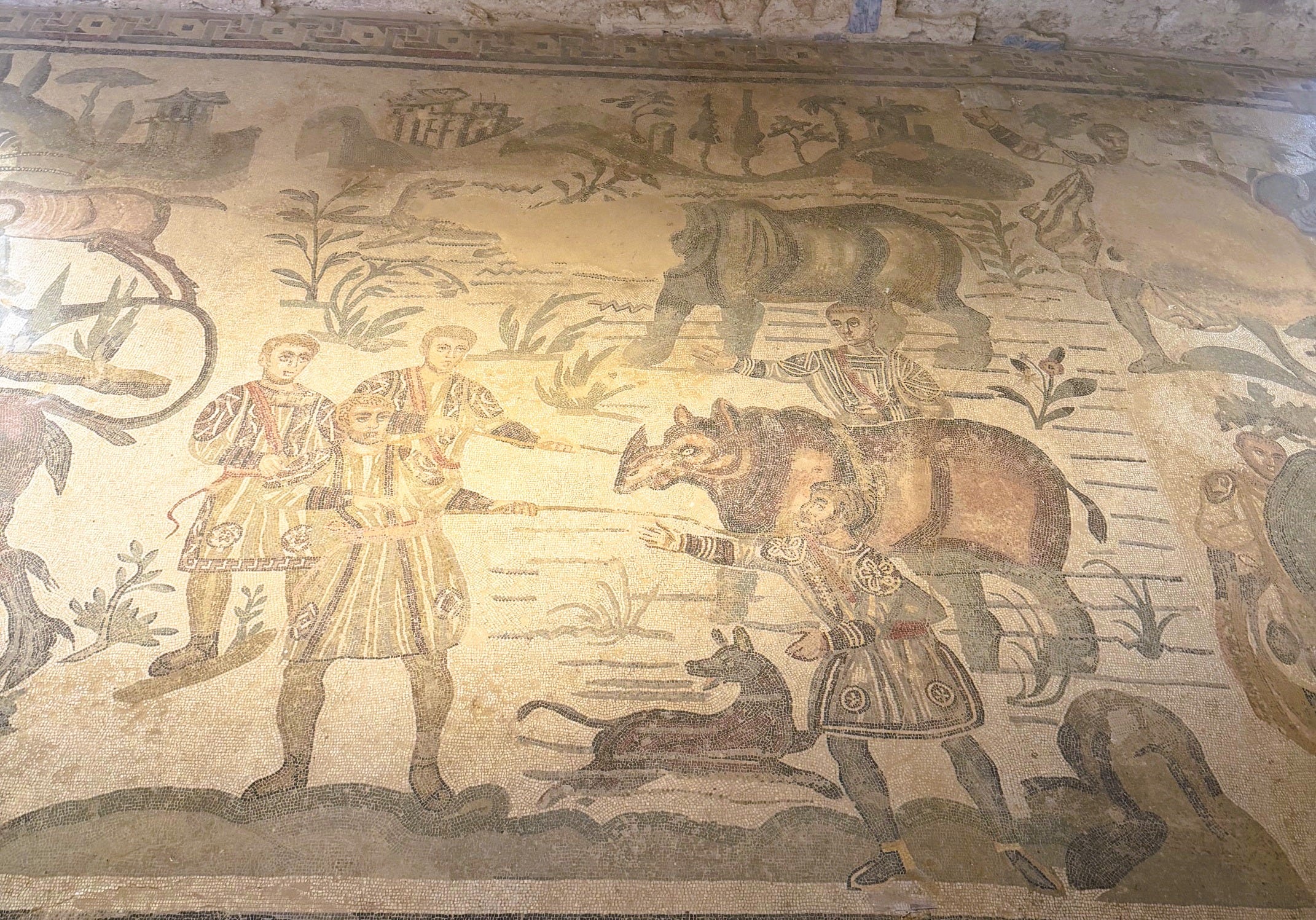
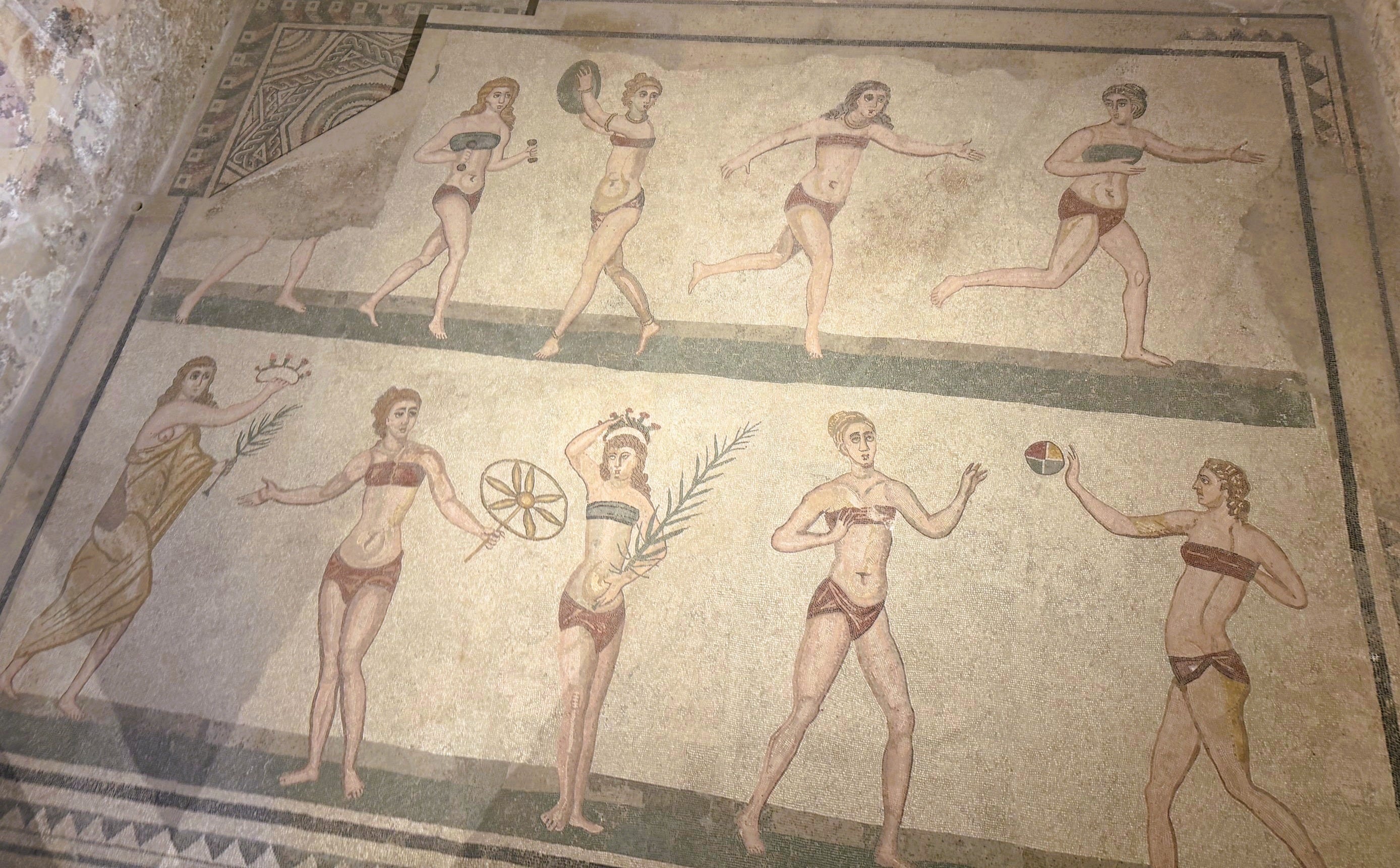
We finished up in Agrigento at the majestic Valley of the Temples. It’s a series of Greek temples that were built atop a ridge overlooking the Mediterranean—a jaw-droppingly beautiful location. It’s easy to see why the Greeks built here. Standing on high between the mountains and the sea, you really feel close to the heavens.
The two best preserved temples are of Juno and Concordia. Here are a few snapshots that give you the feeling of being one with the sky. The verticality of the columns lifts you up even higher, making you feel almost like you’re hovering above the earth below.
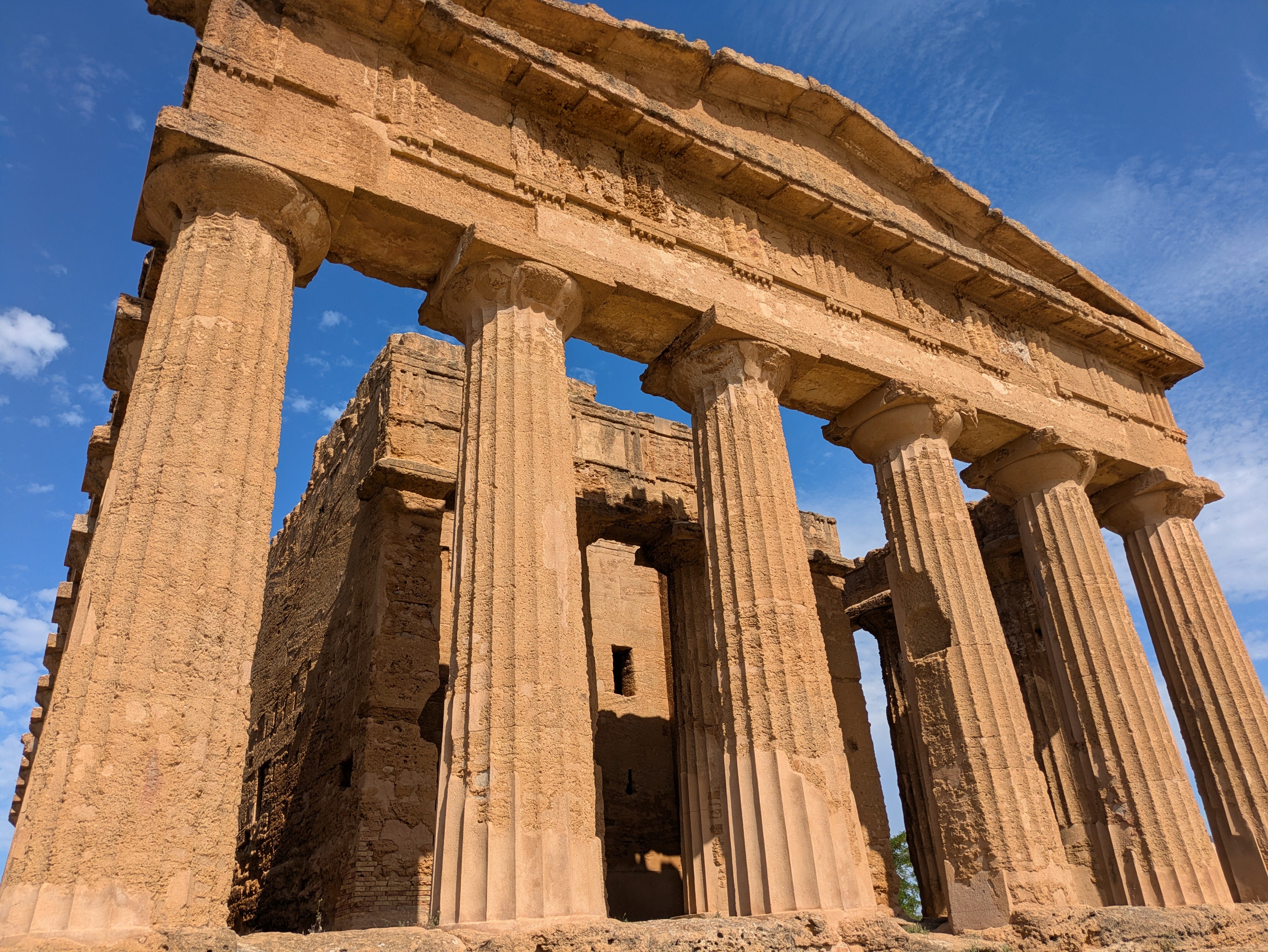
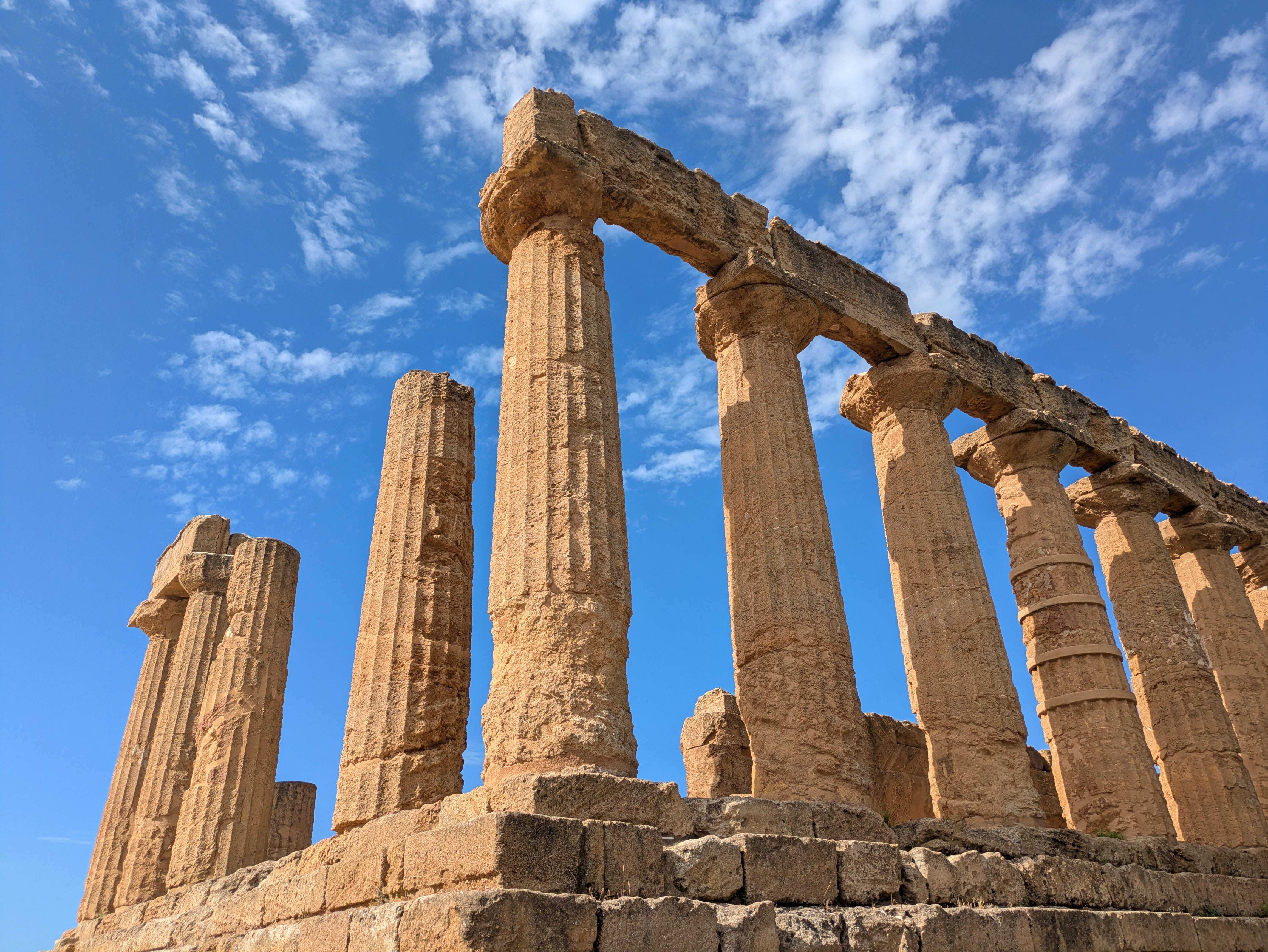
I would highly recommend Sicily if you’d like to go somewhere that truly has everything: beautiful weather, friendly people, delicious food, and, of course, thousands of years of history. Wherever you happen to be in the world, I hope you’ve enjoyed this brief virtual tour.
Yes re Sicily! Agrigento was amazing, as was climbing Etna - as, of course, Seneca, always keen to learn about natural phenomena, urged Lucilius to do: 'If you will write me a full account of these matters, I shall then have the boldness to ask you to perform another task,—also to climb Aetna at my special request. Certain naturalists have inferred that the mountain is wasting away and gradually settling, because sailors used to be able to see it from a greater distance. The reason for this may be, not that the height of the mountain is decreasing, but because the flames have become dim and the eruptions less strong and less copious, and because for the same reason the smoke also is less active by day...' (Letter 79.2)
I'm headed to Sicily in September l and am looking forward to it Thanks for the suggestions. Anything else you loved/would suggest as a must-do for a first-time visitor? Also, I like to read fiction books set in and nonfiction books based on places I'm visiting before/during. Anything in that category for you from Sicily?